

Jamiyasaadiyaarabiya8836@sbi
Open any UPI app — GPay, PhonePe, Paytm or BHIM — and scan this code, or pay directly to the ID above.
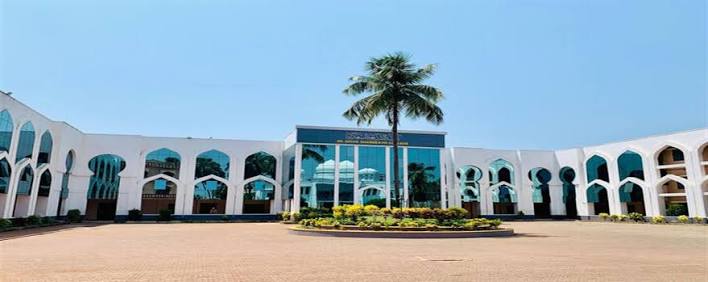
Jamia Sa-adiya Arabiya was established on 28 April 1971 in the very house of Late Kallatra Abdul Khader Haji — a benevolent gentleman widely known and respected for his generosity. What began as a modest initiative to uplift the educationally downtrodden region of North Kerala grew, under his supervision, into a movement whose impact continues to be felt nearly six decades later.
Jamia Sa-adiya Arabiya is a unique Religious, Socio-Cultural, Educational and Charitable Institution with a laudable mission and vision, based in Kasaragod, the northernmost district of Kerala, India. The institution has been registered under the Societies Registration Act and also with the Wakaf Board, Kerala, giving it a firm legal and administrative foundation from which to grow.
Situated on a lovely hillock near the Chandragiri River — six kilometres south of Kasaragod Town, ten kilometres north of Bekal Fort, and seventy kilometres from Mangalore International Airport — at Sa-adabad, Deli, Jamia Sa-adiya Arabiya occupies a setting as significant to its identity as its mission is to its community.
His donation of five acres of land became the foundation on which the institution's infrastructure was built. In 1979, the fledgling institution merged with Samastha Kerala Jamiyyathul Ulama's Kannur District Committee, a union that strengthened its footing and considerably widened its reach across the surrounding districts.
Coming out with multi-faceted programmes to uplift the educationally downtrodden region, Jamia Sa-adiya Arabiya emerged as a prominent educational institution in no time — setting the stage for the decades of expansion that would follow.
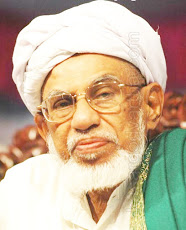
Thajul Ulama Sheikh Abdul Rahman al Bhukhari (1920–2014) was among the senior religious scholars whose guidance shaped Sa-adiya's early direction. His title, Thajul Ulama — "Crown of Scholars" — was not ceremonial but earned, reflecting the deep respect he commanded across the wider Islamic scholarly community in Kerala and beyond.
His involvement lent Sa-adiya both spiritual authority and a firm grounding in traditional Islamic scholarship during its formative years, at a time when the institution needed exactly that kind of credibility to draw students, teachers and support from across the region. The values he helped instil — a balance of rigorous scholarship and genuine humility — continue to define the institution's approach to education today.
Though the details of his tenure are, like much of Sa-adiya's earliest history, preserved more in institutional memory than formal record, his influence is still cited by senior figures within the institution as a touchstone for what Sa-adiya's religious education ought to aspire to.
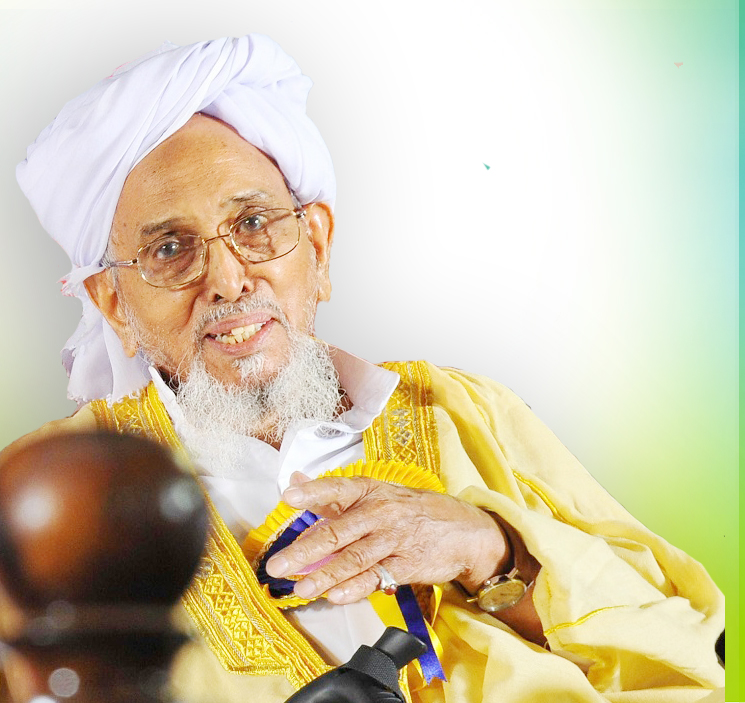
Popularly known as M A Ustad, Janab M A Abdul Khader Musliyar's dynamic leadership transformed Sa-adiya from a promising but modest local initiative into one of the biggest institutions for the socio-cultural development of the Muslim community in North Kerala. Born in 1924 near Trikkaripur, he devoted his early years to religious studies.
An eminent scholar in his own right, he went on to serve as president of Samastha Kerala Jamiyyathul Ulama and the All India Sunni Education Board — positions of influence he used, in no small part, to advocate for institutions like Sa-adiya and the educators who staff them.
Under his guidance, Sa-adiya merged with Samastha Kerala Jamiyyathul Ulama's Kannur District Committee in 1979, considerably expanding its reach. He passed away in 2015 at the age of 91, having authored more than forty works, and was laid to rest at the very campus he had spent decades building.

Kallatra Abdul Khader Haji is remembered as the founder whose vision and generosity gave Jamia Sa-adiya its start. At a time when access to religious and modern education alike was scarce, he chose to open his own house as the institution's first home — a decision reflecting his standing as a man of considerable means and even greater compassion.
His subsequent donation of five acres of land was more than a financial contribution: he envisioned an institution that would outlast any single generation, built on land that belonged to the community's future. That vision continues to guide Sa-adiya's growth today.
Beyond his material gifts, his personal example — quiet devotion, conviction, and a genuine sense of duty — set the tone for the culture Sa-adiya has cultivated ever since. His name endures not as that of a benefactor alone, but as that of a founder in the fullest sense.
Sprawling over 55 acres, Jamia Sa-adiya Arabiya today runs more than 30 institutions, including two orphanages (boys' and girls') and a destitute home. Giving employment to more than 300 personnel, this peerless organization imparts value-based education to more than 10,000 students across Arts, Science and Technical fields.
Prominent institutes under its umbrella include the Islamic Shari'ah College, boarding madrasas, orphanages, a College of Arts & Commerce, a Senior Secondary English Medium School, an Industrial Training Centre and a Computer Training Centre, among others. Together, they represent a deliberate strategy: rather than specialising narrowly, Sa-adiya has grown to serve nearly every stage and type of education a student in the region might need, from early religious instruction through to vocational and higher academic training.
Sa-adiya has also extended its service into healthcare, with the construction of a multi- and super-speciality hospital currently underway — a testament to how the institution continues to grow to meet the community's evolving needs, well beyond the boundaries of its original educational mandate.
Sa-adiya's purpose has always been laudable: to impart material education alongside religious teaching, in the belief that neither is complete without the other. Its contributions to the community are unique and unparalleled, shaping generations of students who go on to serve as scholars, professionals and community leaders in equal measure.
Beyond the classroom, Sa-adiya conducts literary associations, study camps, debating classes, group discussions, mock parliaments and the publication of manuscripts — all aimed at enriching the intellectual and moral development of its students. These activities are treated not as extracurricular add-ons but as essential to what the institution considers a complete education: one that produces confident, articulate individuals capable of engaging thoughtfully with the world beyond the campus.
As Sa-adiya moves into its second half-century, the institution continues to balance the preservation of its founding values with the demands of a changing world. The expansion into healthcare, the ongoing modernisation of its academic institutions, and the continued growth of its charitable programmes all reflect a deliberate effort to remain relevant to the community it serves — without losing sight of the religious and moral grounding that has defined it since 1971.
New campuses, including a growing presence in Kasaragod's neighbouring areas, signal that Sa-adiya's story is far from finished. Each new institution added to its network carries forward the same founding spirit: that education, properly understood, is inseparable from character, community and faith.
The committee spends considerable resources to ensure the smooth running of the institution and to accomplish its objectives, depending mainly on the contributions and assistance of generous hands both in and outside India. None of Sa-adiya's growth over the past five and a half decades would have been possible without this sustained generosity — a continuation, in many ways, of the same spirit of giving that Kallatra Abdul Khader Haji embodied when he first opened his house to the institution in 1971.
The committee expresses its deep and sincere gratitude to all who have extended their help and cooperation over the years, and looks forward to the same continued support as Sa-adiya carries its mission into the decades ahead.